Match the tire and chain plan to the Idaho route
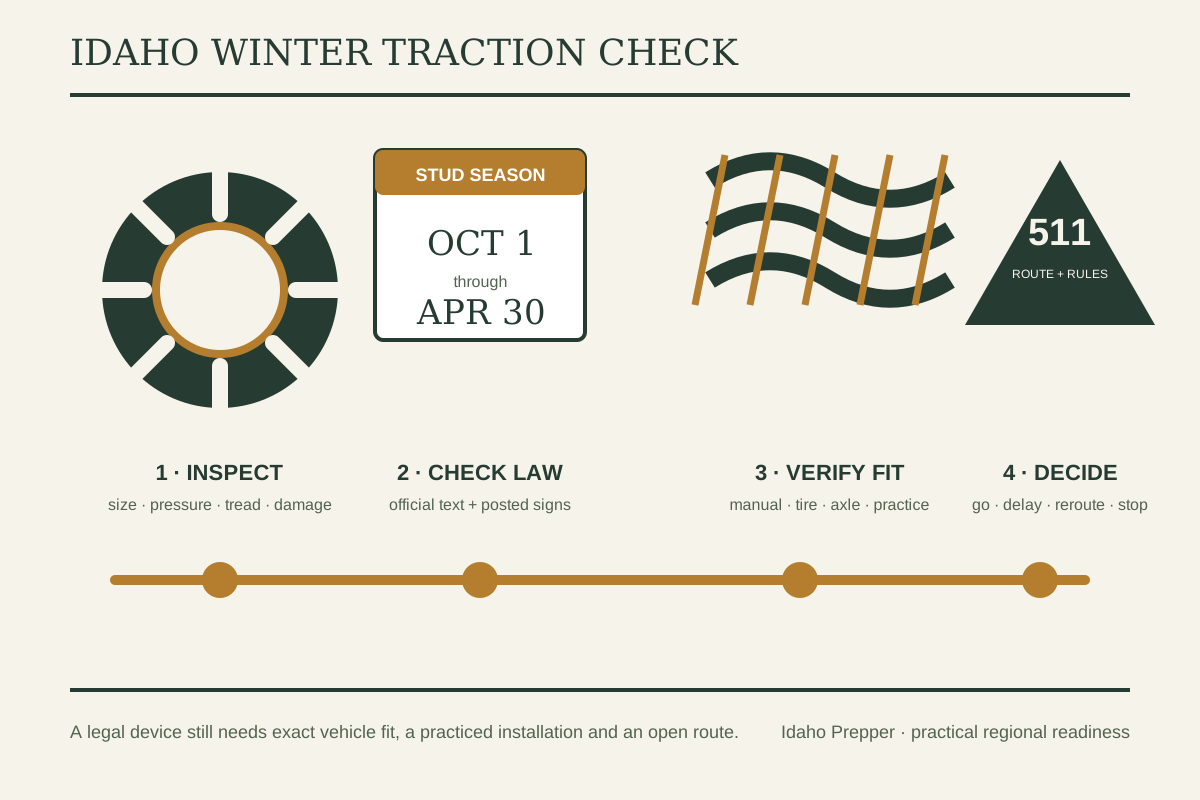
The first snow forecast often triggers three searches at once: Do I need winter tires? Are studs legal yet? Should I carry chains? Those questions share one useful answer: start with the exact vehicle, tire condition, route and current road report. A legal traction device that does not fit the wheel well is not a plan. Neither is a capable tire paired with a closed pass or a driver who has never installed the chains.
Idaho law gives studded tires a defined season and allows tire chains. It also lets the Idaho Transportation Department post chain requirements for specified commercial vehicles on three northern passes when conditions warrant. Passenger-car drivers still need to follow posted traffic controls, closures, their vehicle manual and the law in every state they enter. This guide turns those layers into a pre-trip checklist.
The two-minute answer
- Idaho’s ordinary studded-tire season is October 1 through April 30.
- Idaho’s posted chain provision in Code 49-948 is written for specified commercial vehicles at Lookout, Fourth of July and Lolo passes.
- Passenger vehicles must still obey signs, closures and any applicable instruction.
- Use only tire sizes and traction devices approved for the exact vehicle and installed tire.
- Check pressure cold, inspect tread and damage, and include the spare if equipped.
- Open Idaho 511 and the National Weather Service forecast before departure.
- Delay when the route, vehicle, driver or installation plan does not pass.
Read Idaho’s tire and chain rules in their actual scope
Studded tires: October 1 through April 30
Idaho Code 49-948 generally prohibits vehicles with built-in tire studs on public highways from May 1 through September 30. That makes October 1 through April 30 the ordinary legal season. The statute includes specific exemptions for fire apparatus, properly retracted studs and special exemptions granted by the Idaho Transportation Board. The current Idaho Driver’s Handbook states the same October 1 through April 30 season and notes that ITD can adjust dates in some years because of weather conditions.
A legal date does not establish that studs are the right choice for a household. ITD has noted that studded tires add pavement wear and that nonstudded traction tires can be alternatives. Tire performance changes with road surface, temperature, vehicle, tread and driver behavior. Compare documented tire performance and the route’s usual conditions with a qualified tire professional rather than treating studs as a universal upgrade.
Chains: permitted equipment and a targeted commercial requirement
Idaho Code 49-948 permits tire chains. It also authorizes ITD to require chains on specified commercial vehicles when Lookout Pass or Fourth of July Pass on Interstate 90, or Lolo Pass on U.S. 12, becomes unsafe enough to warrant the restriction. The statute requires advance notice, a safe pullout opportunity and signs; it does not allow that commercial requirement to be posted on bare pavement.
That provision is often shortened online to “Idaho has a chain law,” which hides who and where it covers. Passenger drivers should not copy a commercial-vehicle chaining diagram or assume that the absence of a passenger chain mandate means any car can proceed. Obey every sign, closure and law-enforcement direction. Check Idaho 511 restrictions and the exact route. If travel crosses Montana, Washington, Oregon, Nevada, Utah or Wyoming, read that state’s current rule before leaving; dates and vehicle requirements differ.
Use the official Idaho Legislature text for the current statute. Search summaries, tire-shop pages and forum comments can help reveal questions, but they can omit amendments, exemptions or vehicle definitions.
Inspect what is on the vehicle before shopping
Find the tire size on the sidewall and compare it with the size approved on the vehicle label and owner’s manual. Record tire type, age code, tread condition, pressure, visible damage and whether all four tires match the vehicle manufacturer’s requirements. If the vehicle has a spare, include it.
NHTSA says to check pressure when tires are cold—generally after the vehicle has been parked for at least three hours—and inflate to the vehicle manufacturer’s recommended pressure on the driver-side door label or in the owner’s manual. The number molded on the tire sidewall is a maximum tire value, not the vehicle’s recommended setting. Cold weather lowers tire pressure, so a warm-garage reading can change outdoors.
Inspect tread and sidewalls for cuts, punctures, bulges, scrapes, cracks, uneven wear or other damage. NHTSA identifies 2/32 inch as the federal minimum tread reference and advises professional inspection for damage. Winter capability can deteriorate well before a tire looks bald, and local driving conditions may justify earlier replacement. Ask a qualified tire professional to evaluate the actual set rather than using one penny test as the entire decision.
| Record | Where to find it | Why it matters |
|---|---|---|
| Approved tire size and cold pressure | Driver-door label and owner’s manual | Vehicle-specific fit and inflation |
| Installed tire size and date code | Tire sidewall | Confirms what is actually mounted |
| Tread and physical condition | All tires, including inner sidewalls where visible | Finds wear or damage needing professional review |
| Traction-device restrictions | Owner’s manual | Some wheel/tire positions have limited clearance or prohibitions |
| Load and passenger plan | Door label, manual and trip list | Cargo changes handling and clearance |
Choose tires for the complete route, not the driveway
NHTSA notes that winter tires are more effective than all-season tires in deep snow. A tire carrying the three-peak mountain snowflake mark has met a defined severe-snow traction test, but the symbol does not promise good ice braking, adequate tread, correct fit or safe travel in every storm. Studded, studless winter and all-season designs each involve tradeoffs. Use independent test data for the correct size and conditions, plus the tire and vehicle manufacturer instructions.
Think about the coldest and highest part of the route, not only home. A Boise driveway, a shaded canyon, an I-90 pass and a rural unplowed road can present different surfaces in one day. Note how often the vehicle crosses passes, whether departure can be delayed, the driver’s experience and whether neighboring-state rules apply.
All-wheel drive and four-wheel drive can distribute driving force to more wheels. They do not create extra tire grip for every stop or turn, shorten reaction time, clear blowing snow or make visibility. Tires, speed, following distance and the choice to delay still control the risk. The Idaho State Police advises slower speeds, increased following distance, fewer lane changes and avoiding travel into a storm.
Do not mix tire types, sizes or wear patterns unless the exact vehicle and tire manufacturers permit the configuration. Installing only two winter tires can change front-to-rear grip in ways that make handling less predictable. Ask the tire professional to document size, load and speed ratings, directional mounting, rotation plan and whether the vehicle requires a matched circumference.
Verify chain or cable fit before the return window closes
Begin with the owner’s manual. Search the traction-device, tire-chain and winter-driving sections for permitted tire sizes, axle position, clearance class, maximum speed, installation method and any prohibition. Some vehicles allow low-clearance devices only; others prohibit chains on a particular wheel and tire combination because they can contact brakes, suspension, sensors, bodywork or wiring.
Then use the traction-device maker’s current fit chart for the exact tire size. A label that says “SUV,” “universal” or “fits most” is not enough. The same vehicle model can ship with several wheel sizes, and replacement tires can differ. Keep the receipt, fit documentation and instructions with the vehicle.
A chain-fit record
- Vehicle year, make, model and drive configuration
- Exact tire size on the installed sidewall
- Owner’s-manual page and permitted axle
- Required clearance or device class
- Traction-device model and maker fit-chart revision
- Maximum installation and driving speed
- Retightening or self-tensioning instructions
- Compatible gloves, mat, light and storage bag
- Safe pullout plan before the grade
Never test chains by driving on bare public pavement. Do a stationary fit in a dry, level, well-lit place, then follow the product’s exact practice procedure. A device that cannot be installed without contacting the vehicle fails. Do not alter a chain, improvise fasteners, defeat a sensor or guess where excess links should go.
Practice the full installation while hands are warm
Lay every part out at home. Read the instructions from start to finish. Identify inside and outside surfaces, hooks, tensioners and the correct travel direction. Put on the gloves and kneeling layer that live in the kit. Practice on the actual installed tires, not a loose spare with different access.
- Park on a level, dry surface, set the parking brake and keep the vehicle off according to its manual.
- Confirm the device is untangled and oriented correctly.
- Install on the axle and tire position named by the vehicle manual.
- Check that no part contacts a brake line, suspension component, sensor wire or bodywork.
- Tension and inspect exactly as the device maker directs.
- Follow any short-movement and retightening instruction only in a safe practice area.
- Remove, dry and repack the device in installation order.
Time the practice without turning it into a race. If installation requires a posture, grip or strength a traveler does not have, solve that before the trip. That may mean a different approved device, help from another trained passenger or delaying travel. Roadside conditions add darkness, cold, traffic, spray and poor footing.
On the road, use only a designated chain-up area or another lawful location well clear of moving traffic. Never stop in a travel lane, at a blind curve or where snowplow operations need the space. Wear high-visibility outerwear if available, keep passengers protected and follow posted instructions.
Make Idaho 511 the final gate
Equipment preparation happens before the storm; the travel decision happens against current conditions. Open Idaho 511 before departure. Check road-condition segments, closures, incidents, restrictions, cameras, weather alerts and message signs across the complete route. Our Idaho 511 go-or-delay checklist explains how to read those layers without treating one camera as proof.
Compare 511 with the National Weather Service forecast and alerts for home, the pass and the destination. Write a delay trigger: a closed segment, difficult report beyond the driver’s experience, chain installation that has not been practiced, a tire problem, a winter warning during the travel window, or a route with no safe stopping point.
Check again from a safe parking place before a major pass or junction, or let a passenger check while moving. The driver should not study a phone. Do not drive around a closure or follow navigation onto an unverified back road. A legal stud date and chains in the trunk do not override a stop decision.
Pair this plan with the Idaho winter car kit and the winter alert action guide. Pack a shovel, warm layers, water, food, light, charger and medicines for the people traveling. Idaho State Police recommends a full fuel tank, winter washer fluid, tow equipment and emergency traction material. Secure every heavy item.
Print the tire-and-chain decision card
- Vehicle / drive configuration: ______________________________
- Installed tire size: _________________________________________
- Door-label cold pressure: front ______ rear ______ spare ______
- Tire condition checked by / date: ___________________________
- Studded or studless plan: __________________________________
- Owner’s-manual chain page: _________________________________
- Approved device / axle: ____________________________________
- Dry installation practiced: _________________________________
- Idaho 511 route report / time: ______________________________
- NWS alert and timing: ______________________________________
- Neighboring-state rule checked: _____________________________
- Delay or turn-back trigger: _________________________________
Questions Idaho drivers ask
When can I put studded tires on in Idaho?
The ordinary Idaho season is October 1 through April 30. Check the current Idaho statute and ITD notices because the Transportation Board can grant specific exceptions or adjust dates when authorized.
Does Idaho require passenger cars to carry chains?
Idaho Code 49-948’s posted pass requirement is written for specified commercial vehicles. Passenger drivers should still obey all signs and closures, check current restrictions, and carry only devices approved for their exact vehicle when the route and conditions justify them. Other states may require passenger vehicles to carry or use traction devices.
Are snow cables the same as chains?
They are different designs. Idaho’s commercial pass law defines chains and permits an alternative device only when it provides equal or greater traction under similar conditions. For a passenger vehicle, the owner’s manual and device fit documentation determine what may be installed; a cable is not automatically approved because it is thinner.
Can I put chains on all-wheel drive?
Only as the exact owner’s manual directs. The permitted axle and device depend on wheel-well clearance, tire size and drivetrain design. Do not choose an axle by guesswork or a general all-wheel-drive rule.
Official sources checked
- Idaho State Police — Winter Driving Safety
- Idaho Transportation Department — Idaho Driver’s Handbook
- Idaho Legislature — Idaho Code 49-948, Restrictions as to Tire Equipment
- Idaho 511 — current road conditions, closures, restrictions and cameras
- Idaho 511 — service FAQ
- National Highway Traffic Safety Administration — Winter Weather Driving Tips
- National Highway Traffic Safety Administration — Tire Safety
Reviewed October 27, 2026. Public discussions were used to identify recurring confusion about stud dates, passenger versus commercial chain rules, all-wheel drive, cable fit and neighboring-state requirements. Current law, posted controls, exact manuals and official route information govern the trip.
More official Idaho information and local contacts →