Idaho winter storm watch vs. warning: what should you do?
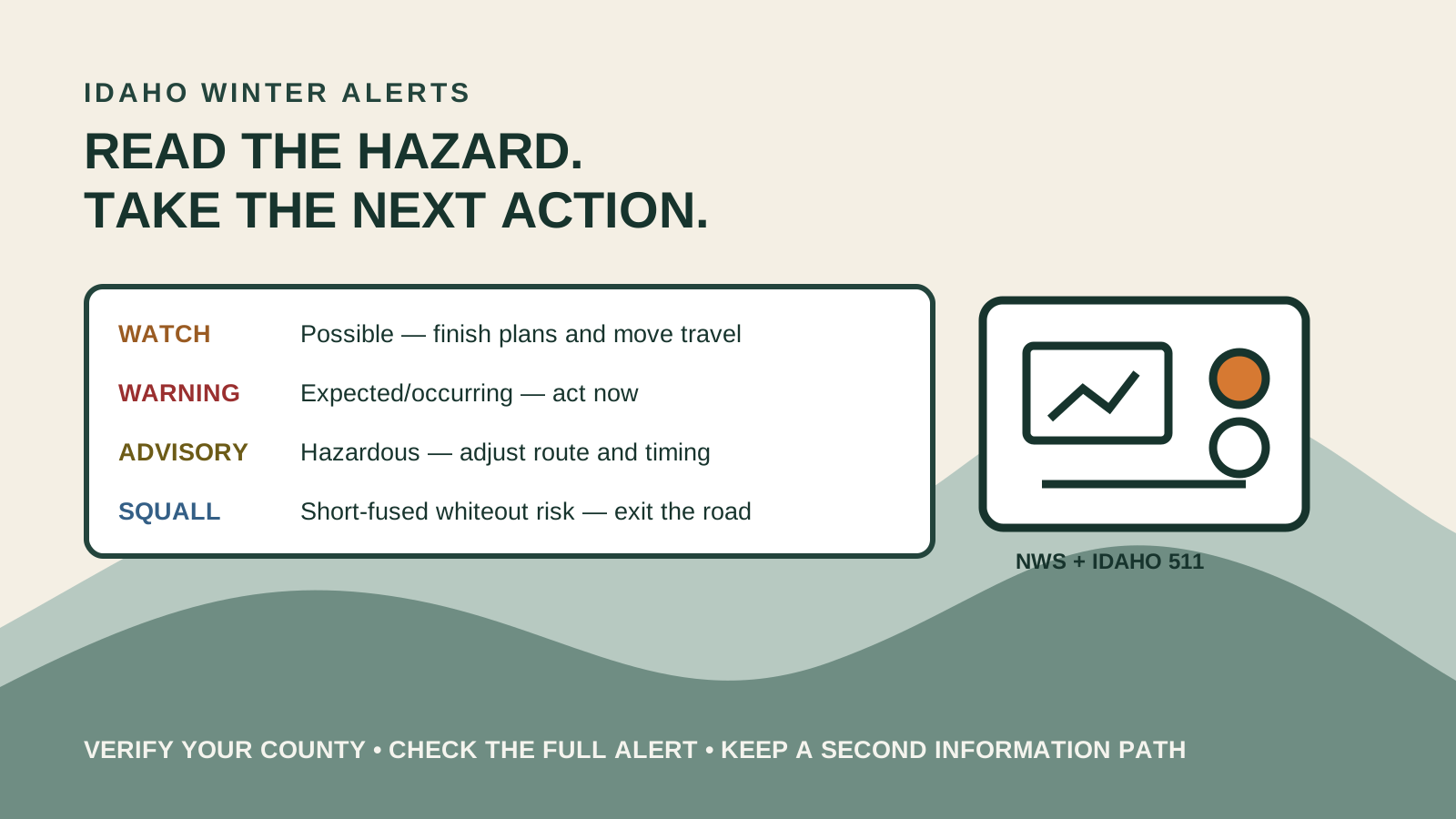
A winter alert is useful only when it changes a decision. “Watch,” “warning,” and “advisory” describe different levels of confidence and impact, but the alert text matters more than the label alone. It names the counties or forecast zones, the timing, expected snow or ice, wind and visibility, and the actions the National Weather Service recommends.
Idaho adds another layer: a drive can cross a mild valley, an exposed interstate segment and a mountain pass in the same trip. A forecast for home does not automatically describe the whole route. Check the alert for each area, then compare it with current road conditions from Idaho 511.
The short version: possible, expected, hazardous
| Alert | Plain-language meaning | Useful response |
|---|---|---|
| Winter Storm Watch | Significant winter weather is possible, but timing, location or intensity is still uncertain. | Finish preparations, reconsider travel timing and monitor updates. |
| Winter Storm Warning | Significant snow, ice, sleet, blowing snow or a dangerous combination is expected, imminent or occurring. | Act now. Avoid unnecessary travel and follow the full alert instructions. |
| Winter Weather Advisory | Winter weather is expected to create hazardous or disruptive conditions below warning criteria. | Adjust plans. Allow more time and do not treat “advisory” as “safe.” |
| Blizzard Warning | Strong wind with falling or blowing snow is expected to reduce visibility severely for hours. | Shelter in place when possible; avoid travel until conditions improve. |
| Snow Squall Warning | A short, intense burst can cause sudden whiteout visibility and rapidly slick roads. | Delay entry or safely exit the road at the next opportunity and wait for it to pass. |
The exact snow and ice thresholds vary by National Weather Service forecast office and terrain. That is one reason not to memorize a single inch total. Open the alert and read the “what,” “where,” “when,” and “impacts” sections for your location.
When a winter storm watch is issued
A watch is planning time. The Weather Service generally issues it when hazardous winter weather is possible within roughly the next day or two. It may be upgraded to a warning or advisory, changed as the storm track shifts, or canceled. A watch is not a promise that the storm will arrive, and it is not a reason to wait before doing the easy work.
- Check every household member’s schedule and identify travel that can move earlier or later.
- Charge phones, power banks, rechargeable lights and essential medical devices.
- Confirm prescriptions, infant supplies, pet food and familiar no-cook meals.
- If a private well depends on electricity, fill safe drinking-water containers.
- Move vehicles where snow removal, emergency access and falling branches are less likely to trap them.
- Test the NOAA Weather Radio and confirm a second information path.
Pair the watch with the Idaho first-freeze home checklist and power-outage plan. The goal is to finish before travel deteriorates or stores become crowded.
When a warning replaces the watch
A winter storm warning means the hazardous event is expected, imminent or underway. Re-read the new alert; do not assume it is merely a stronger version of the earlier forecast. The affected area, start time, precipitation type and wind may have changed.
Move from preparation to protection. Cancel or delay discretionary travel. Bring pets into the planned safe area. Put flashlights, medications, water and warm layers where everyone can reach them. Keep vents and outdoor appliance exhausts clear as snow accumulates. If power fails, use the Idaho generator safety guide before starting portable backup power.
“Warning” does not mean every road closes or every household receives the same snow depth. It means the forecast hazard meets warning criteria for the named area and requires action. Local terrain can make impacts worse or better within short distances.
Why an advisory still changes the plan
A winter weather advisory covers expected snow, ice, sleet, freezing rain or blowing snow that may not reach warning criteria but can still make untreated roads, sidewalks and rural routes hazardous. Lower totals can be disruptive during a commute, after a long dry period, or where elevation changes create abrupt freezing.
Use an advisory to reduce exposure: move appointments, shorten the route, allow extra time and avoid optional pass travel. Check that the person driving has the winter car kit, appropriate tires, fuel and a charged phone. The label is a forecast product, not permission to travel.
Blizzard and snow squall are visibility alerts
A blizzard is defined by wind and visibility, not by extreme cold or a particular new snowfall total. The National Weather Service uses sustained winds or frequent gusts of at least 35 mph with falling or blowing snow reducing visibility to one-quarter mile or less for at least three hours. Old snow can blow; a blizzard warning can matter even when fresh totals seem modest.
A snow squall is shorter and faster. NOAA describes it as an intense burst of snow that can create sudden whiteout conditions and a flash freeze. A warning is often short-fused. If one covers the route, delay departure. If already driving, do not stop in an active lane or on the travel portion of the shoulder. Slow gradually, turn on headlights, avoid abrupt braking, increase following distance and take the next safe exit when possible. NOAA advises waiting 30 to 60 minutes, or until the warning expires, before resuming.
Build two alert paths before winter
Idaho’s Office of Emergency Management explains that authenticated alerts can reach the public through Wireless Emergency Alerts on compatible phones, the Emergency Alert System on radio and television, and NOAA Weather Radio. County and tribal systems may add local evacuation, shelter or road information.
- Keep emergency alerts enabled on household phones.
- Find the official alert signup for your county or tribe through its emergency-management office.
- Save the relevant National Weather Service forecast-office page and Idaho 511.
- Program a NOAA Weather Radio for the county or counties you need, then test reception where the radio will stay.
- Write the utility outage number and local emergency-management contact on paper.
Mountain terrain can limit weather-radio reception. The Weather Service station search warns that coverage can be partial or blocked by distance and terrain, so test the actual location rather than assuming the nearest transmitter will work indoors. Do not rely on a single app, social account or cell connection.
A five-minute alert-reading drill
Use an expired alert or a harmless forecast; do not wait for severe weather. Have each adult answer:
- Which counties or forecast zones are included?
- When does the alert begin and end?
- What precipitation, wind, visibility and temperature hazards are named?
- Does the alert cover home, the destination, or the entire route?
- Which action changes now: travel, school pickup, livestock care, well water, power backup or medication?
- Where will the next official update come from?
Then open Idaho 511 and identify the winter-road status, closures, incidents and cameras for one normal route and one alternate. A camera is a snapshot, not proof that the next mile is clear. The drill succeeds when the household can turn a label into a specific decision without searching for an influencer’s interpretation.
Common alert mistakes
- Reading only the push-notification headline. The full alert contains the location, timing and hazards.
- Checking only the weather at home. Idaho routes cross elevation and forecast zones.
- Assuming a watch must become a warning. Forecast confidence and storm tracks change.
- Ignoring an advisory. Ice and blowing snow can be dangerous below warning thresholds.
- Equating blizzard with snowfall total. Wind and low visibility define the hazard.
- Disabling every loud alert after one interruption. Review settings carefully and keep a reliable emergency-warning path.
Official sources checked
- National Weather Service: Winter Weather Warnings, Watches and Advisories
- NWS Spokane: Winter Weather Terms
- NOAA: Four Tips for Snow Squall Safety
- Idaho 511: Current Road Conditions
- Idaho Office of Emergency Management: Emergency Communications
- National Weather Service: NOAA Weather Radio Station Search
Reviewed October 13, 2026. Always follow the current alert, local officials and posted road closures.
More official Idaho information and local contacts →