Watch the building—not a universal snow-depth number
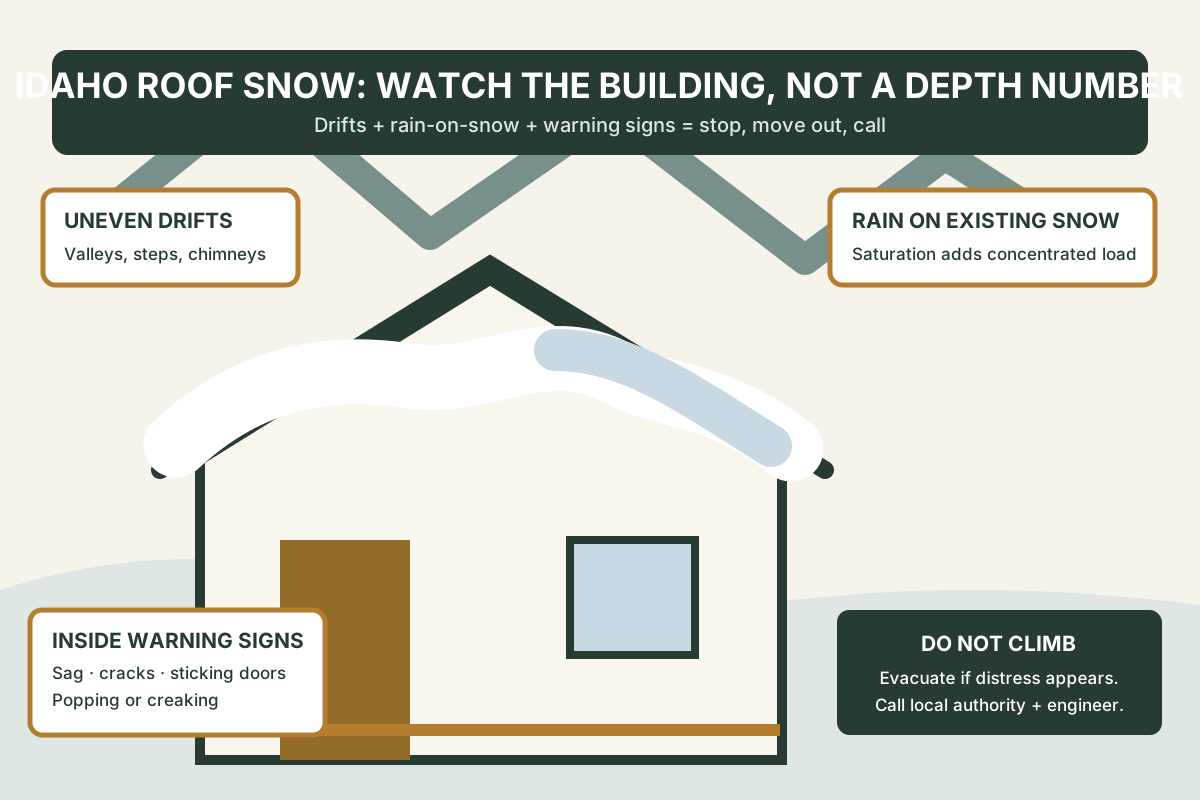
Two roofs on the same Idaho street can carry the same storm differently. One may have a steep, simple shape and documented local design load. The other may have a low-slope addition, a drift pocket behind a taller wall, blocked drainage, age-related damage, or a manufactured-home requirement that differs from the neighboring house. Snow depth alone cannot settle the question.
FEMA’s snow-load guidance points to two better signals: how snow is distributed and what the building is doing under it. Uneven drifting, sliding snow, rain soaking an existing snowpack, ice dams, and meltwater trapped on a low-slope roof can concentrate load. New sagging, cracks, sticking doors, severe leaks, or unusual popping and creaking can indicate distress. Those are reasons to leave—not reasons to climb up for a closer look.
If structural distress appears
- Get everyone out promptly and keep people away from the building and the snow-shed zone.
- Call emergency services for an immediate collapse danger or anyone trapped or injured.
- Contact the local building authority and a qualified structural design professional.
- Do not enter to collect belongings, inspect the attic, or start snow removal.
- Keep vehicles and responders out of areas where snow, ice, roofing, or walls could fall.
Build the roof record before the first heavy storm
Find the property file, original plans, engineering documents, manufactured-home data plate or installation instructions, and records for additions, solar panels, rooftop equipment, repairs, or prior leaks. The number you need is not a statewide “Idaho roof limit.” Design conditions vary by jurisdiction, elevation, exposure, roof shape, occupancy, and construction.
Ask the city or county building department what records it has and which adopted code applies. An Idaho-licensed structural engineer can interpret design information, assess modifications, and create a property-specific observation and removal plan. Idaho’s manufactured-home installation standard notes that new homes sold in the state must meet at least a 30-pound-per-square-foot roof snow load, while some jurisdictions require more; that range is a reminder to check the exact home, not a reason to assume 30 psf is safe for every structure.
Photograph ceilings, wall intersections, roof lines, doors, windows, porch posts, and visible framing before winter. Note an old crack, sticky door, sag, or leak so a seasonal change is easier to recognize. Save the building department, insurer, engineer, roofer, landlord, and emergency contacts offline.
Read the sequence, not only the snowfall total
Fresh, dry snow and old, wet snow can have very different weights. FEMA emphasizes that rain on existing snow can saturate the snowpack and increase roof load. Wind can move snow into deep drifts beside parapets, chimneys, dormers, rooftop equipment, valleys, stepped roofs, and walls where a lower roof meets a taller section.
Track the National Weather Service forecast and alerts for the building’s location and elevation. Note new snowfall, wind direction and gusts, temperature changes, rain, and additional storms arriving before the roof has shed or drained. Idaho’s Office of Emergency Management warns that winter storms can last for hours or days and disrupt heat, power, roads, and communication. A contractor who is reachable before a pass closes may not be reachable after.
| Weather pattern | Why it matters | Planning response |
|---|---|---|
| Wind after new snow | Creates uneven drifts and concentrated load | Observe known drift zones from a safe ground location |
| Rain on snow | Adds water and may increase the load rapidly | Move the professional call earlier; watch drainage and distress signs |
| Freeze–thaw cycle | Can form ice, block drainage, and move meltwater | Check interior leaks and ground-level drainage paths |
| Repeated storms | Loads can accumulate before the roof sheds | Maintain a storm log and act on the property-specific threshold |
| Sudden warming | Snow and ice may slide from metal or steep roofs | Keep entrances, fuel tanks, walkways, people, and pets out of the shed zone |
Inspect from the ground and from normal occupied rooms
Do not climb onto an icy roof, lean a ladder against a snow-loaded structure, or walk beneath overhanging snow and icicles. Use a location outside the likely slide and collapse zone. Binoculars or a camera zoom can help record drift patterns without moving closer.
From outside, look for snow that is clearly deeper in a valley, behind an obstruction, on one roof plane, or where a high wall meets a low roof. Note bowed gutters, blocked scuppers or drains visible from the ground, severe ice accumulation, new roof-line changes, and snow pressing against vents. Never chip ice around electrical service, gas equipment, or a roof edge.
Inside, stay in ordinary occupied areas only while the building shows no distress. Compare doors, windows, ceilings, walls, and visible framing with the baseline photographs. Do not enter an attic to investigate a suspicious sound or sag. Do not assume a leak is “only an ice dam”; severe leaks are among FEMA’s listed warning signs and water may also reach electrical systems.
Treat these as evacuation signs, not repair clues
FEMA lists common signs of overstress in wood, steel, and metal buildings. One sign does not prove snow caused it, but several new changes during a snow event deserve immediate caution:
- sagging ceiling tiles, boards, roof decking, or visible roof members;
- bowed truss members, sprinkler lines, or sprinkler heads dropping below a suspended ceiling;
- popping, cracking, or creaking from the structure;
- doors or windows that suddenly cannot open or close;
- new cracks in walls, masonry, or structural wood;
- cracked or split wood members;
- severe roof leaks or water collecting where a low-slope roof should drain.
If a door is suddenly stuck, do not waste time proving why. Use another safe exit if available, get people out, and make the professional calls. If the exit route itself is beneath a slide zone, use the household emergency plan and emergency services guidance.
After evacuation, do not re-enter because the noise stopped or the snow began melting. A qualified authority must determine when the building is safe. Keep the Idaho winter alert action guide available so the household also tracks road closures, warming locations, and official instructions.
Decide about snow removal without creating a new hazard
FEMA warns that unsafe roof access and falling snow or ice can injure people. Removal can also create dangerously unbalanced loading if one area is stripped while another remains deep, and tools can damage roofing, vents, wiring, solar equipment, or membranes. The safest default is not to climb onto the roof.
Ask the building authority, structural engineer, roof manufacturer, and a qualified, insured snow-removal professional to establish the threshold and method for this building. Confirm fall protection, liability coverage, how the crew will protect entrances and utilities, where removed snow will land, and how it will avoid removing or damaging roofing material. A contractor should also account for power lines, skylights, chimneys, solar panels, propane tanks, accessibility routes, and emergency exits.
A long-handled roof rake used from the ground is sometimes recommended for appropriate simple roofs, but it is not universally safe. People can be struck by the snow they pull down, lose footing, contact overhead utilities, damage roofing, or change the load pattern. Use one only when the building and tool instructions support it, the operator remains clear of the fall zone, and a professional has not advised a different approach.
Do not use a snow blower on a roof. Do not add water or chemical deicer to “lighten” the snow. Do not strike ice with an axe or shovel. Do not hire an uninsured person whose plan is simply to walk on the loaded roof.
Include rentals, manufactured homes, sheds, carports, and barns
Renters should report deep drifting, leaks, sticking doors, new cracks, or unusual sounds to the landlord or property manager immediately and keep a written record. Do not alter the roof or hire a contractor without authorization unless emergency services direct otherwise. Know two exits and do not store belongings where a blocked door would trap them.
Detached garages, porch roofs, patio covers, lean-tos, greenhouses, sheds, barns, and older additions may not share the main home’s design or condition. Keep people, livestock, and vehicles out when any structure shows distress. For agricultural buildings, include the veterinarian, county emergency manager, insurer, and an engineer familiar with that construction in the plan.
Manufactured-home owners should keep the data plate and installation information available and verify local requirements. Never assume the neighboring home’s snow-load rating applies. Additions such as porch roofs and carports can also shed onto or brace against the home in ways that deserve professional review.
Print the roof-snow observation card
- Building / outbuilding: ____________________________________
- Local building authority: __________________________________
- Engineer / qualified contractor: _____________________________
- Documented design information: ____________________________
- Known drift zones: _______________________________________
- Safe observation point: ___________________________________
- Evacuation exits and meeting place: _________________________
- Storm date / new snow / wind: ______________________________
- Rain or warming forecast: __________________________________
- New sag, crack, leak, noise, or sticking door: ________________
- Professional advice / time: _________________________________
- Removal or re-entry decision made by: _______________________
Photograph from the same safe locations after each major weather change. A consistent record helps a qualified professional understand what changed; it does not substitute for an inspection.
Questions Idaho households ask after heavy snow
How many inches are too many?
There is no trustworthy universal depth. Density, drifting, rain-on-snow, roof geometry, drainage, design, age, condition, and alterations all matter. Use documented building information and professional guidance.
Is a metal roof automatically safe because it sheds snow?
No. Metal roofs can shed suddenly, creating a hazard below, and obstructions or roof geometry can still collect drifts. Snow guards, gutters, entrances, tanks, parked vehicles, and neighboring roofs need a site-specific plan.
Should I break an ice dam?
Do not climb up or chip at roofing. Ice-dam work can damage the roof and place the worker beneath falling ice. Address active water and electrical hazards, then use a qualified contractor and correct the underlying insulation, air-leakage, ventilation, and drainage problems with appropriate professionals.
What if I hear one loud pop?
FEMA includes popping, cracking, and creaking among warning signs. Leave promptly, keep others out, and contact the local building authority and a qualified design professional. Do not stay inside to wait for a second sound.
Official sources checked
- FEMA — Snow Load Safety Guidance
- FEMA P-957 — Snow Load Safety Guide
- Idaho Office of Emergency Management — Navigating Winter Storms
- Idaho Office of Emergency Management — Severe Weather Safety
- Idaho State Historical Society — Disaster Preparedness Guidelines
- Idaho Division of Occupational and Professional Licenses — Manufactured Home Installation Standard
Reviewed November 5, 2026. Public discussions were used to identify recurring questions about snow depth, roof rakes, metal roofs, rain on snow, sticking doors, and ice dams. Safety recommendations rely on the official sources above. Local building officials and Idaho-licensed design professionals should interpret a specific structure.
More official Idaho information and local contacts →